What is Bone Graft Surgery for Teeth Implants?

What is Bone Graft Surgery?

Bone graft surgery is a procedure to help bone grow or heal where there is bone damage or deficiency. Bone grafting is sometimes called guided tissue regeneration. Whether or not you need bone grafting for dental implants and extractions comes down to many factors.

dental implants bone loss

sinking face

Bone Grafting may be Needed in the Following Situations:

  1. Teeth Extraction sites to help bone grow back properly into the bony socket. Also called socket preservation. Socket preservation helps prevent long term bone loss, and helps grow bone for dental implants to be placed where teeth have been extracted.
  2. Infections caused by failed Root Canals
  3. Implant surgery to help grow bone around implants. Especially helps grow bone when implants are placed at the same time as tooth removal. This is very common when doing full mouth implant cases where several teeth are being removed and implants are being placed at the same time
  4. Grow bone in areas where there is not enough bone for implants
  5. Grow bone to improve gum health and cosmetics around existing teeth and implants.
  6. Wisdom teeth extraction sites
  7. Grow bone in atrophied sinuses

How is Bone Grafting done with Dental Implant Surgery?

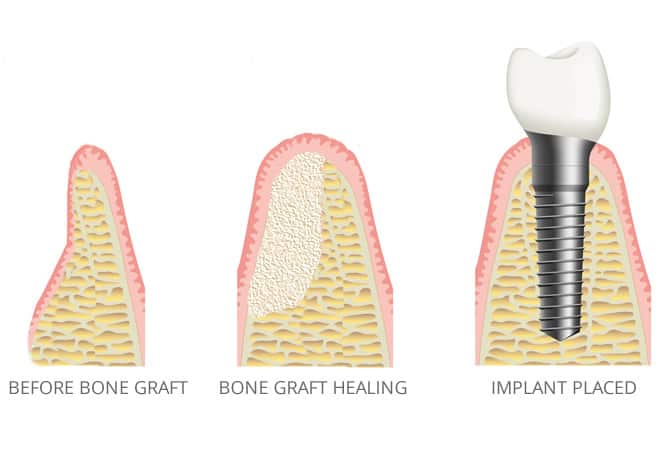
The most common reason to perform bone graft procedures is for dental implant surgery. There are two categories: The first is placing the bone graft where implants are done after a healing period. That is bone graft surgery and delayed dental implant placement. This kind of bone graft is considered pre-surgical ridge augmentation. Generally, this is done when the area to be grafted has had an extensive infection which has destroyed the native bone and compromised the success of placing a dental implant. In this situation, the infected area is cleaned, and new bone is added (this acts as a scaffold to allow the persons body to replace it with their own natural bone). The site is revisited for implant surgery after 3-6 months of healing.

block bone graft

bone grafting implants

Bone Loss Occurs After Tooth Loss

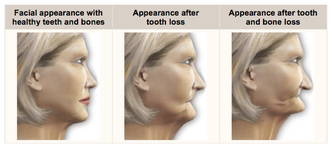
In the absence of infection, the area can undergo bone loss simply based off of time without a tooth present. The teeth hold the bone levels and without a tooth present, the jaw bones can become atrophied over time. In this event, pre-surgical ridge augmentation or bone graft surgery may be necessary prior to getting dental implants, as described above.

Immediate Implant Surgery Often Requires Bone Grafting

The second kind of bone graft surgery is when the bone graft is done at the time of implant placement. This type of bone graft is usually done when the site is 75% of the way intact, but with only one portion of the bone in question. The implant is placed and bone graft is added to the area similarly to the way potting soil is added when re-potting a plant. The newly added bone heals around the dental implant and the original defect is repaired.

What Are the Different Ways to Do Dental Implant Surgery?

Same Day Immediate Implant vs After Grafting and Healing

By Dr. Gary Adams who has successfully done thousands of dental implants in Burtonsville near Silver Spring, Clarksville and Columbia Maryland. Dr Adams does single implants and full mouth dental implant surgery.

Gary Adams DDS Holistic Dentist

dr gary adams

Single tooth replacement with a Dental Implant procedure can be in one of two Different Ways:

What is Immediate Dental Implant Surgery:

Immediate implant is where a bad tooth is taken out and an implant is put into the jawbone on the same day. The situation is where there is a bad tooth (the one that needs to be removed) is currently occupying the space where a tooth replacement needs to go. This is opposed to where there is no tooth present and a new tooth is desired.

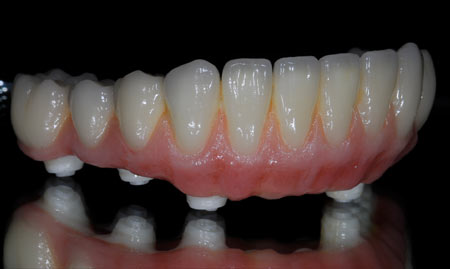
Immediate implants is often done when replacing a full set of teeth with implants. A full upper or lower set of teeth can be replace with implants in different ways. Some implant teeth are permanent and others such as implant dentures are removable teeth. The implant surgeon will remove all the bad teeth, put in new implants and do any necessary bone grafting at the same time. Usually, the dentist puts in a new set of teeth that the patient will use during the healing period.

same day implant

immediate dental implant

What is the advantage of immediate implant surgery?

  1. Save time
  2. Only get one surgical procedure when a tooth is removed and an implant is done during the same procedure.
  3. Better gum and bone healing – gum tissue and bone tissue do not collapse into an extraction site when implant surgery is done with tooth extraction
  4. Better gum and bone healing – the body is ready to heal when a tooth is removed. The healing is typically better and can be stronger when a implant is done with the extraction.
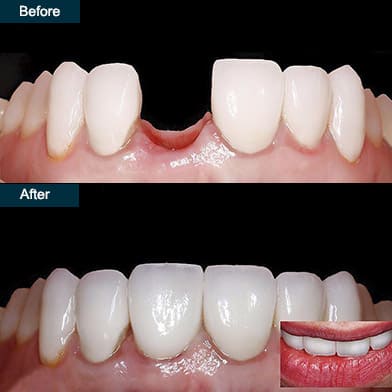
  5. Better cosmetic and more natural looking results. If gum and bone are not lost, a tooth implant looks more like a natural tooth with proper gum proportions around the tooth.
  6. Shorter time without a tooth. How long would you want to go without your front tooth? Or any tooth for that matter?

For cases of Dental Anxiety it may be necessary to have sedation dentistry, but it is not required.  We offer IV sedation. Anesthesia can be achieved with a local anesthesia just like what is used for a dental filling.  Laughing gas aka NO2 can also be used as a twilight sedative for implant surgery.

Delayed Dental Implant Surgery vs Immediate

In the event the dental implant is unable to be placed, due to lack of bone support or a large jaw infection, sometimes the proper clinical decision is to do a bone graft, let the body heal and “delay” the implant surgery to a later date. In some cases a healing period may be necessary to achieve optimal results. In general, the body can take up to 6 months for this to happen, although it is often times a shorter wait.

Delayed placement, or placing an implant where there is currently no tooth, is a usually a straight-forward procedure.

How Long does it Take to get a tooth replaced with Dental Implants?

  1. The first appointment for a dental implant, whether taking the tooth out and placing the implant or simply placing the implant can be conceptualized as replacing the root of the tooth first. The body is allowed to heal for roughly 2-3 months.
  2. During the second appointment, an impression of the surrounding teeth and gums in addition to the dental implant is taken for the lab to craft a new crown (the portion of the tooth one sees.) This appointment does not require dental anesthesia.
  3. The third and final appointment, roughly 1-2 weeks later, the final dental implant crown is delivered to the patient along with a connector called an abutment. The patient’s bite is checked and the esthetics are verified. Some minor adjustments may be necessary but in general, no dental anesthesia is required.

There are also other varieties of the dental implant procedure for other scenarios including replacing multiple teeth at a time or using implants to secure dentures.

Other Popular Blog Posts:

Other popular pages:

Call Now Button